Why Low-Saturation Outfits Often Look More Expensive
Learn how muted colors, fabric, tailoring, and accessories work together to create a polished outfit impression.
Search Intent
This guide answers an informational search question: Learn how muted colors, fabric, tailoring, and accessories work together to create a polished outfit impression.
Quick Judgment
- Muted color lowers outfit noise.
- Fabric and tailoring set the quality ceiling.
- Accessories should be few but consistent.
Best For
- People comparing Outfit directions before looking at example results
- Readers who want the decision logic behind "Why Low-Saturation Outfits Often Look More Expensive"
- Users who want to remove weak options before uploading a photo
Self-Check
- Muted color lowers outfit noise.
- Fabric and tailoring set the quality ceiling.
- Accessories should be few but consistent.
- Check first: Simplify the color system
- Check first: Tailoring is the real base
Decision Steps
Simplify the color system
Ivory, light grey, black, brown, misty blue, and soft rose are easier to combine than high-saturation clashes. The fewer the colors, the more fabric and line quality matter.
Tailoring is the real base
Muted outfits still look weak when the shape is sloppy. Clean shoulders, neckline, waist placement, and draping fabric create the polished effect.
Finish with quiet accessories
Small metal earrings, a slim belt, a compact bag, and simple shoes add refinement. Accessories do not need to be many, but they should point in the same direction.
Comparison
| Decision point | Better-fit signal | Caution signal |
|---|---|---|
| Simplify the color system | Simplify the color system matches your face, color direction, scenario, or maintenance level. | Simplify the color system is only trend-led and does not match your real daily conditions. |
| Tailoring is the real base | Tailoring is the real base matches your face, color direction, scenario, or maintenance level. | Tailoring is the real base is only trend-led and does not match your real daily conditions. |
| Finish with quiet accessories | Finish with quiet accessories matches your face, color direction, scenario, or maintenance level. | Finish with quiet accessories is only trend-led and does not match your real daily conditions. |
Common Mistakes
- Judging from one result image without checking face shape, skin tone, scenario, or maintenance.
- Treating a trend name as the answer while ignoring proportion, value, chroma, silhouette, and use case.
- Jumping straight into generation or shopping before removing high-risk directions.
After the decision framework, related cases become more useful: the case shows what an AI result can look like, while the guide helps decide which direction is worth trying.
Low-Priority Visual Reference
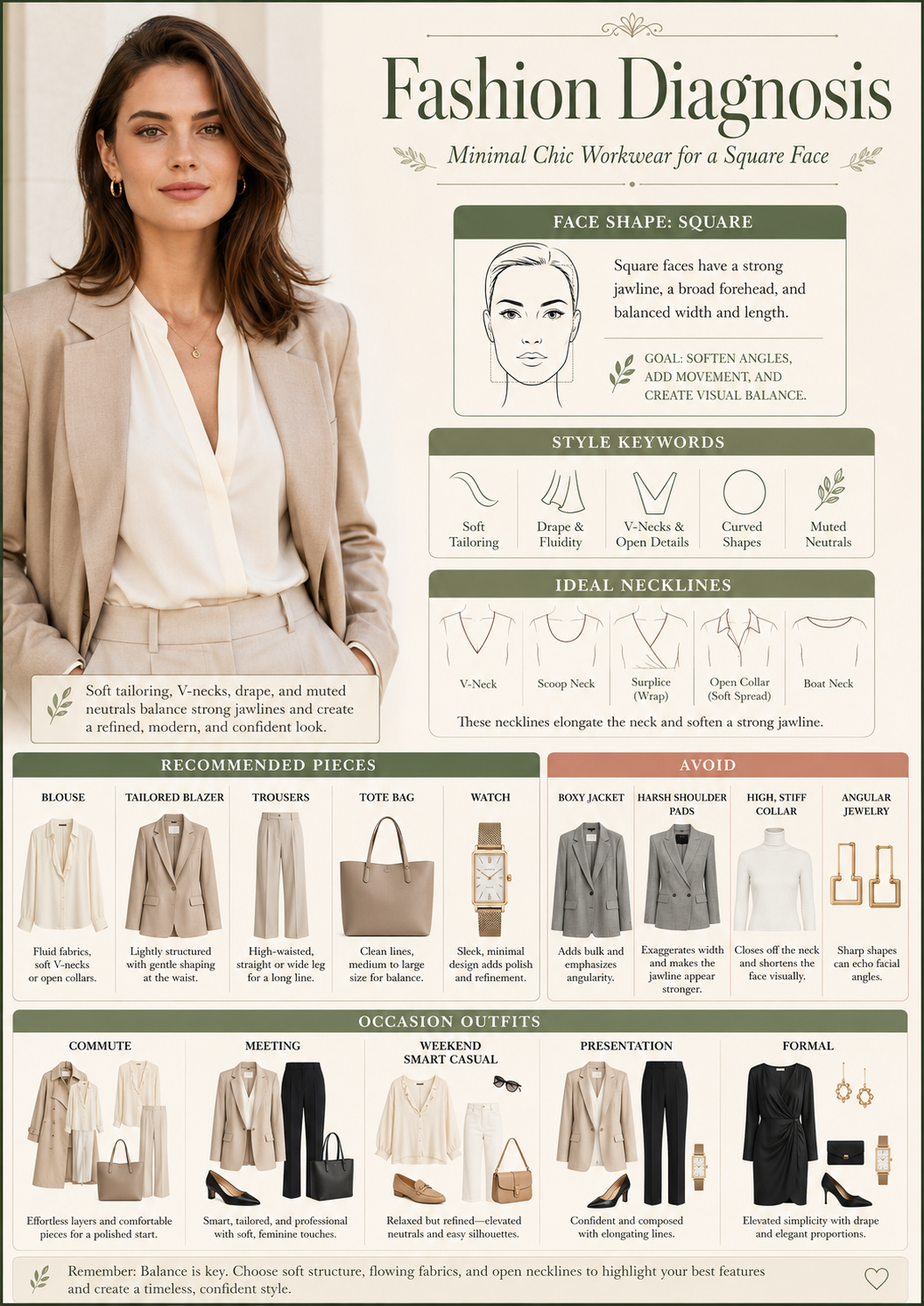
AI outfit style guidance example
See an Example Result
Fashion Diagnosis Case
A minimal chic workwear direction for a square face, using soft tailoring, V-necks, drape, and muted neutrals.
Personal Color Case
A light spring palette for a heart-shaped face, using warm, clear, light colors for a fresh radiant impression.
Full Image Diagnosis Case
A cool elegant style report for a diamond face, combining hair, makeup, color palette, outfits, and summary points.
Keep Reading
How to Build a Capsule Wardrobe for Real Life
A capsule wardrobe is not just owning fewer clothes. It is making every piece easier to combine and closer to your image direction.
How Personal Color Analysis Works: A Simple Seasonal Color Guide
Personal color is not just a season label. It is a practical range of colors that makes your skin look cleaner.
Before AI Virtual Try-On: How to Tell If a Garment Is Worth Trying
AI virtual try-on is most useful when it helps you eliminate weak directions before buying or styling.
Generate your outfit style direction
Get colors, fabrics, necklines, silhouettes, and scene-based outfit guidance.
Start outfit analysis