How to Know If You Suit Light Makeup or Bold Makeup
Use facial feature strength, facial blank space, color capacity, and scenario needs to decide makeup intensity.
Search Intent
This guide answers an informational search question: Use facial feature strength, facial blank space, color capacity, and scenario needs to decide makeup intensity.
Quick Judgment
- Stronger features can carry more contrast.
- More facial blank space needs horizontal balance.
- Everyday makeup and camera makeup can follow different rules.
Best For
- People comparing Makeup directions before looking at example results
- Readers who want the decision logic behind "How to Know If You Suit Light Makeup or Bold Makeup"
- Users who want to remove weak options before uploading a photo
Self-Check
- Stronger features can carry more contrast.
- More facial blank space needs horizontal balance.
- Everyday makeup and camera makeup can follow different rules.
- Check first: Read feature strength
- Check first: Balance facial blank space
Decision Steps
Read feature strength
People with strong brows, eyes, nose bridge, or lips can usually carry higher contrast. Softer features may lose their natural impression under heavy liner or deep lipstick.
Balance facial blank space
When the face has more open space, blush, brows, and lip color help distribute attention. If only the eyes are strong, the whole face can look top-heavy.
Separate daily and photo makeup
Work makeup needs cleanliness and trust. Date makeup can add softness. Photo makeup can use more contrast. One routine does not need to serve every scene.
Comparison
| Decision point | Better-fit signal | Caution signal |
|---|---|---|
| Read feature strength | Read feature strength matches your face, color direction, scenario, or maintenance level. | Read feature strength is only trend-led and does not match your real daily conditions. |
| Balance facial blank space | Balance facial blank space matches your face, color direction, scenario, or maintenance level. | Balance facial blank space is only trend-led and does not match your real daily conditions. |
| Separate daily and photo makeup | Separate daily and photo makeup matches your face, color direction, scenario, or maintenance level. | Separate daily and photo makeup is only trend-led and does not match your real daily conditions. |
Common Mistakes
- Judging from one result image without checking face shape, skin tone, scenario, or maintenance.
- Treating a trend name as the answer while ignoring proportion, value, chroma, silhouette, and use case.
- Jumping straight into generation or shopping before removing high-risk directions.
After the decision framework, related cases become more useful: the case shows what an AI result can look like, while the guide helps decide which direction is worth trying.
Low-Priority Visual Reference
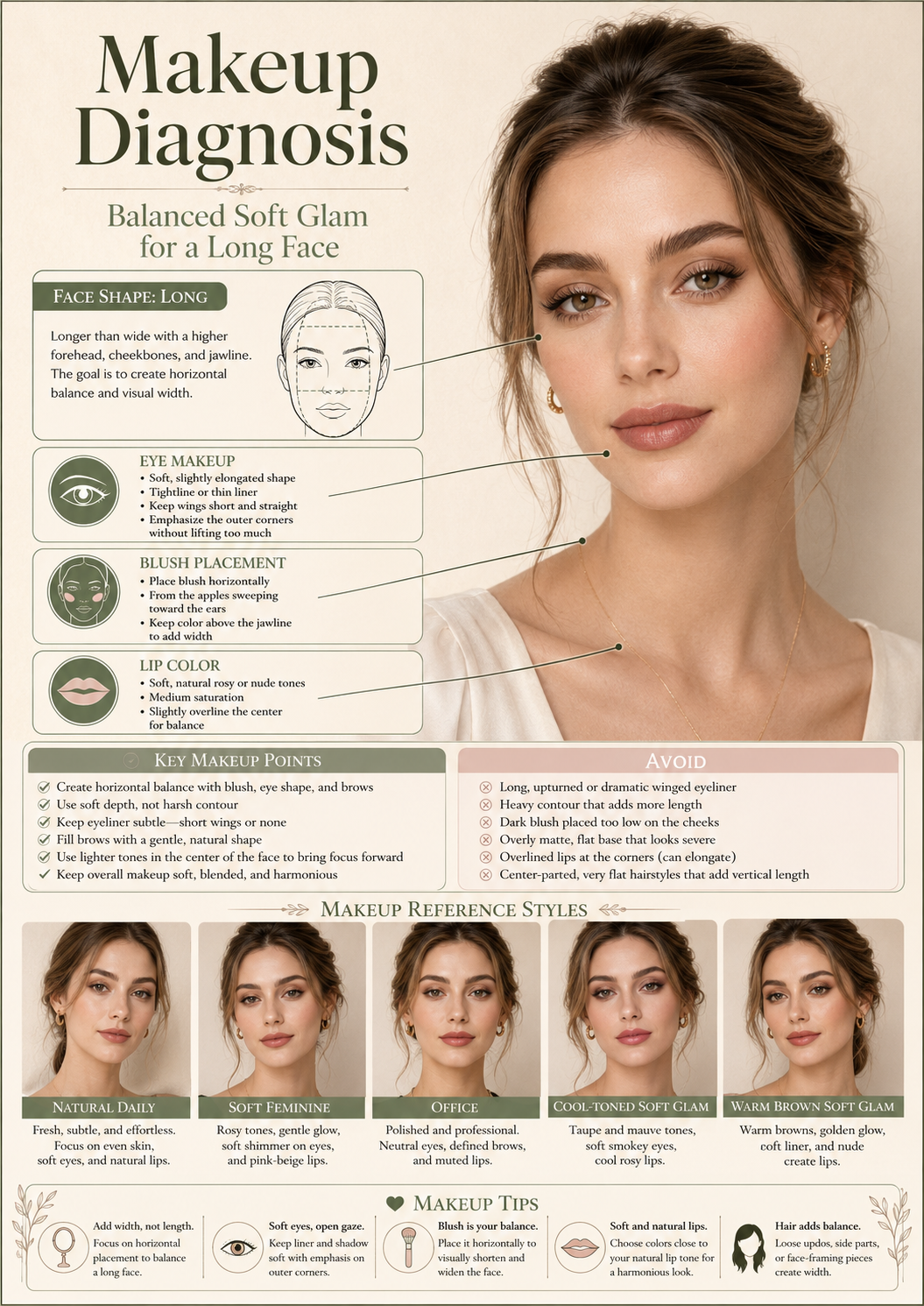
AI makeup style analysis example
See an Example Result
Makeup Diagnosis Case
A balanced soft glam direction for a long face, focused on horizontal balance, soft eyes, blush placement, and natural lips.
Personal Color Case
A light spring palette for a heart-shaped face, using warm, clear, light colors for a fresh radiant impression.
Full Image Diagnosis Case
A cool elegant style report for a diamond face, combining hair, makeup, color palette, outfits, and summary points.
Keep Reading
How Personal Color Analysis Works: A Simple Seasonal Color Guide
Personal color is not just a season label. It is a practical range of colors that makes your skin look cleaner.
Are Curtain Bangs or Air Bangs Better for a Round Face?
For a round face, bangs should lengthen the center and lighten the sides rather than simply cover the forehead.
What Hair Color Looks Brighter and Still Works for Work?
A flattering work-friendly hair color balances brightness, polish, and maintenance instead of simply going lighter.
Build your makeup direction
Find whether clean, work-ready, soft mood, or bold makeup suits you better.
Start makeup analysis