What Hair Color Is Best for Me? A Five-Factor Method That Actually Works
Find your best hair color using undertone, contrast, eye color, natural depth, and upkeep—not skin tone alone. Includes a self-check and salon brief.
Quick answer
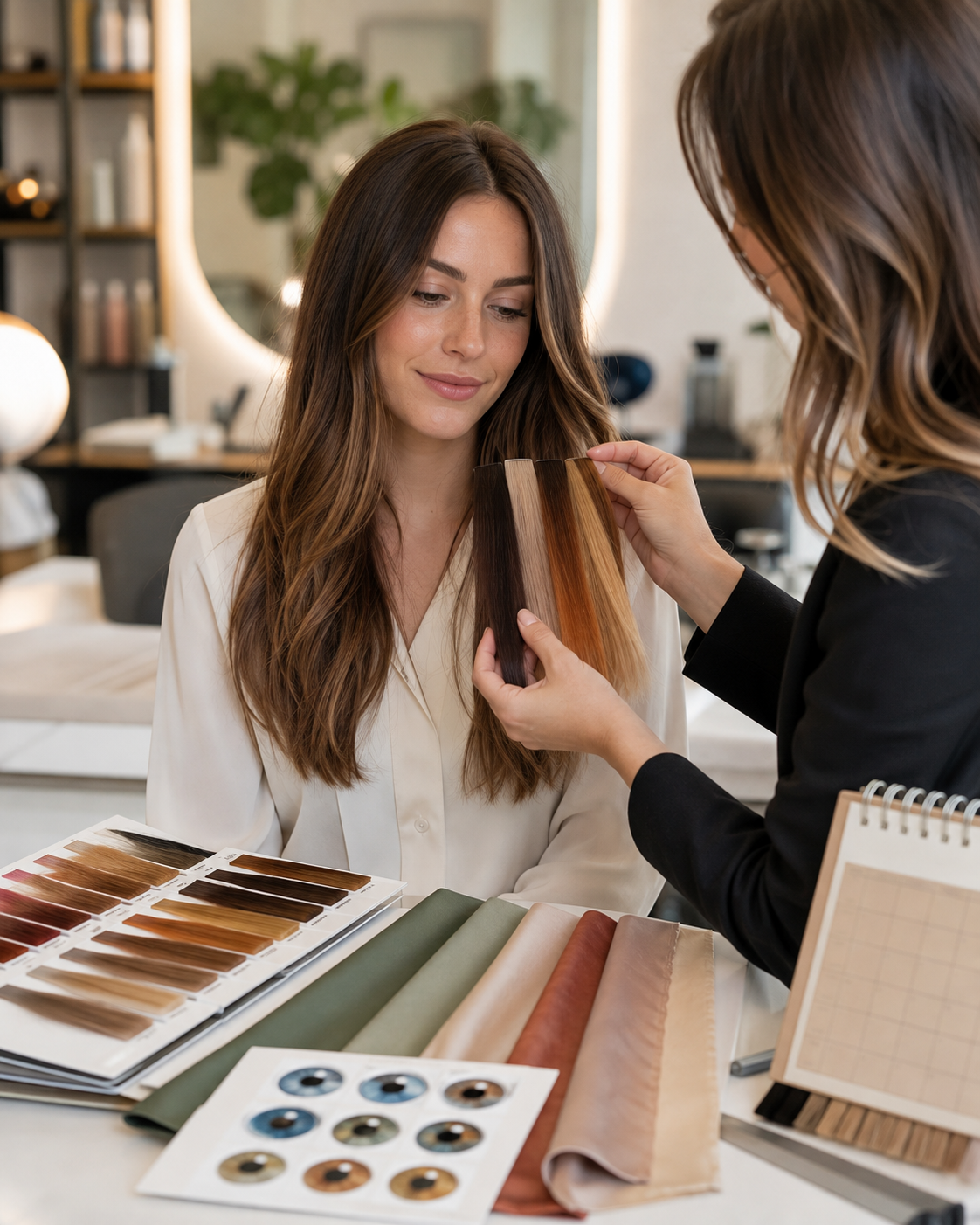
The best hair color for you is not simply "warm for warm skin, cool for cool skin." A flattering result balances five things: your skin's undertone, your natural light–dark contrast, eye color, starting hair depth, and the amount of maintenance you will realistically accept. If a color satisfies only one of those factors, it may look attractive on a swatch but disconnected on your face.
Article
Start with depth before tone
Depth means how light or dark the hair appears. It usually changes your face more dramatically than whether the shade is ash, neutral, or golden. Moving one or two levels from your natural color tends to preserve harmony. Moving four or more levels can be beautiful, but it changes eyebrow contrast, makeup needs, root visibility, and often hair condition.
Use this quick test:
Then identify undertone—without relying on one trick
Vein color and jewelry tests are useful clues, not final answers. Check several signals in indirect daylight: whether your skin looks clearer beside cream or optic white; whether peach or blue-pink blush looks more natural; and whether your complexion tends to read golden, rosy, olive, or balanced. Olive skin can be especially misleading because it may have a cool or neutral undertone beneath a green-gold surface tone.
- Warm or golden undertones often harmonize with honey brown, caramel, chestnut, copper, and warm beige.
- Cool or rosy undertones often suit mushroom brown, cool chocolate, ash beige, burgundy, and controlled blue-black.
- Neutral undertones can usually wear both families, with depth and saturation becoming the deciding factors.
- Olive skin often benefits from neutral-warm or neutral-cool shades rather than extremely yellow or gray formulas.
Let your eyes refine the choice
Hair color does not need to match the eyes; it should create useful contrast around them. Green and hazel eyes often become clearer beside copper, auburn, chestnut, or golden-brown accents. Blue and gray eyes can stand out beside cool brown, beige blonde, or a softly warm shade that creates contrast. Deep brown eyes work with almost every family, so skin clarity and overall contrast should lead.
Decide how much upkeep you actually want
A theoretically perfect shade is a poor recommendation if you dislike monthly appointments. Ask yourself:
1. Will visible roots bother me after four to six weeks?
2. Am I willing to use toning or color-safe products?
3. Does my current hair tolerate lightening?
4. Do I want a subtle improvement or an identity-level change?
For low maintenance, choose balayage, a root melt, subtle face-framing pieces, or a gloss near your natural level. For high impact, all-over copper, very light blonde, fashion colors, and high-contrast black can work—but require a clearer maintenance plan.
A salon-ready brief
Instead of saying "make me brunette," say: "I want to stay within two levels of my natural base, keep the root soft, add neutral-warm dimension around the face, and avoid anything very orange or gray. I can maintain color every eight to twelve weeks." Bring two reference images you like and one you dislike; the negative example often prevents more mistakes than another inspiration photo.
Try the decision on your own face
A generic chart cannot measure how a shade interacts with your actual brows, eyes, face contrast, and current hair. Use StylePersona Hair Color Analysis to compare color directions on your photo while preserving your facial identity, then review the hair color case before choosing a salon brief.
Comparison
| What you notice | Usually test first | Why |
|---|---|---|
| Your features look soft and low-contrast | shades close to your natural depth | prevents the hair from overpowering the face |
| Dark brows and defined eyes | medium-to-deep dimensional colors | repeats existing contrast |
| Very fair skin with delicate features | controlled light or medium shades | avoids a heavy "helmet" effect |
| Tan or deep skin with strong contrast | rich brunette, dimensional black, copper, or strategic brightness | gives definition without looking flat |
Salon-ready brief
“Instead of saying "make me brunette," say: "I want to stay within two levels of my natural base, keep the root soft, add neutral-warm dimension around the face, and avoid anything very orange or gray. I can maintain color every eight to twelve weeks." Bring two reference images you like and one you dislike; the negative example often prevents more mistakes than another inspiration photo.”
Common Mistakes
- Choosing from a celebrity photo without comparing lighting, makeup, and starting color.
- Treating "ash" as automatically sophisticated; too much gray can drain muted or warm complexions.
- Going darker without planning brow balance.
- Ignoring previous dye when estimating what can be achieved in one session.
- Picking a high-maintenance result because it looks good only on appointment day.
A generic chart cannot measure how a shade interacts with your actual brows, eyes, face contrast, and current hair. Use StylePersona Hair Color Analysis to compare color directions on your photo while preserving your facial identity, then review the hair color case before choosing a salon brief.
FAQ
Should hair be lighter or darker than skin?
Neither is universally better. What matters is intentional contrast. Similar depth creates softness; greater contrast creates definition and drama.
Is natural hair color always the most flattering?
It is usually a reliable baseline, not necessarily the optimum. Small changes in warmth, dimension, or face-framing brightness can improve harmony without replacing your natural identity.
Can I choose hair color from skin tone alone?
No. Skin tone narrows the range, but natural depth, eye color, hair condition, style, and upkeep determine whether the result works in real life. ---
Editorial Sources
- American Academy of Dermatology: healthy hair tips - Dermatologist-reviewed guidance on hair type, washing, conditioning, and heat-damage prevention.
- American Academy of Dermatology: coloring and perming tips - Dermatologist guidance on shade changes, patch testing, sun exposure, and chemical-service caution.
- StyleLens AI model disclosure - Product-specific disclosure for AI model use, generation limitations, and human-review expectations.
Related Cases
Keep Reading
What Hair Color Looks Brighter and Still Works for Work?
A flattering work-friendly hair color balances brightness, polish, and maintenance instead of simply going lighter.
How Personal Color Analysis Works: A Simple Seasonal Color Guide
Personal color is not just a season label. It is a practical range of colors that makes your skin look cleaner.
Which Hairstyle Makes Your Face Look Smaller? A Face Shape Guide
A face-slimming hairstyle is not about hiding your face. It is about balancing crown lift, face-framing layers, and hair weight.
Compare color directions on your photo
Upload a photo and compare realistic hair color directions before you commit.
Start analysis