How to Choose the Best Hair Color: A Before-the-Salon Checklist
Use this step-by-step checklist to choose hair depth, undertone, placement, maintenance level, and a clear salon reference.
Quick answer
Choose a hair color in this order: goal, depth, tone, placement, upkeep, then technical feasibility. Most disappointing color decisions reverse that order—they begin with a trendy shade name and only later consider whether it suits the person, can be achieved safely, or is maintainable.
Article
Step 1: Define the visual goal
Pick one primary goal: look brighter, look softer, create definition, emphasize eye color, appear more polished, or make a noticeable transformation. "I just want a change" is emotionally valid but technically vague. A clear goal helps decide whether you need all-over color, dimension, face framing, or simply a gloss.
Step 2: Choose the depth range
Start within two levels of your natural base unless you deliberately want a major transformation. Staying close makes roots softer and usually protects hair condition. If you want to go much lighter, ask whether the desired image depends on studio lighting, extensions, or heavy styling. If you want to go much darker, test how the shade interacts with brows and skin without makeup.
Step 3: Select a tone family
Do not choose between only "warm" and "cool." Add neutral as a meaningful option. Many wearable colors are hybrids: neutral-warm chestnut, cool-neutral cocoa, or beige blonde. Extremes photograph dramatically but are less forgiving in everyday light.
Step 4: Decide where the color should appear
- Face-framing brightness directs attention toward the eyes and cheekbones.
- Lightness through the ends creates movement with softer regrowth.
- A darker root adds depth and reduces maintenance.
- Uniform color looks graphic and polished but exposes roots more quickly.
- Fine highlights create blended brightness; wider ribbons create visible contrast.
Step 5: Set your maintenance ceiling
Write down the longest interval you will tolerate between appointments. If that number is twelve weeks or more, avoid a result that looks unfinished after six. Choose softer roots, balayage, blended gray strategies, or a gloss close to your natural depth.
Step 6: Check feasibility
Your color history matters. Box dye, henna, repeated bleaching, smoothing treatments, and fragile ends change what can be done safely. An AI preview can clarify the destination, but only a colorist who sees and tests the hair can assess the chemical route.
Build a useful reference board
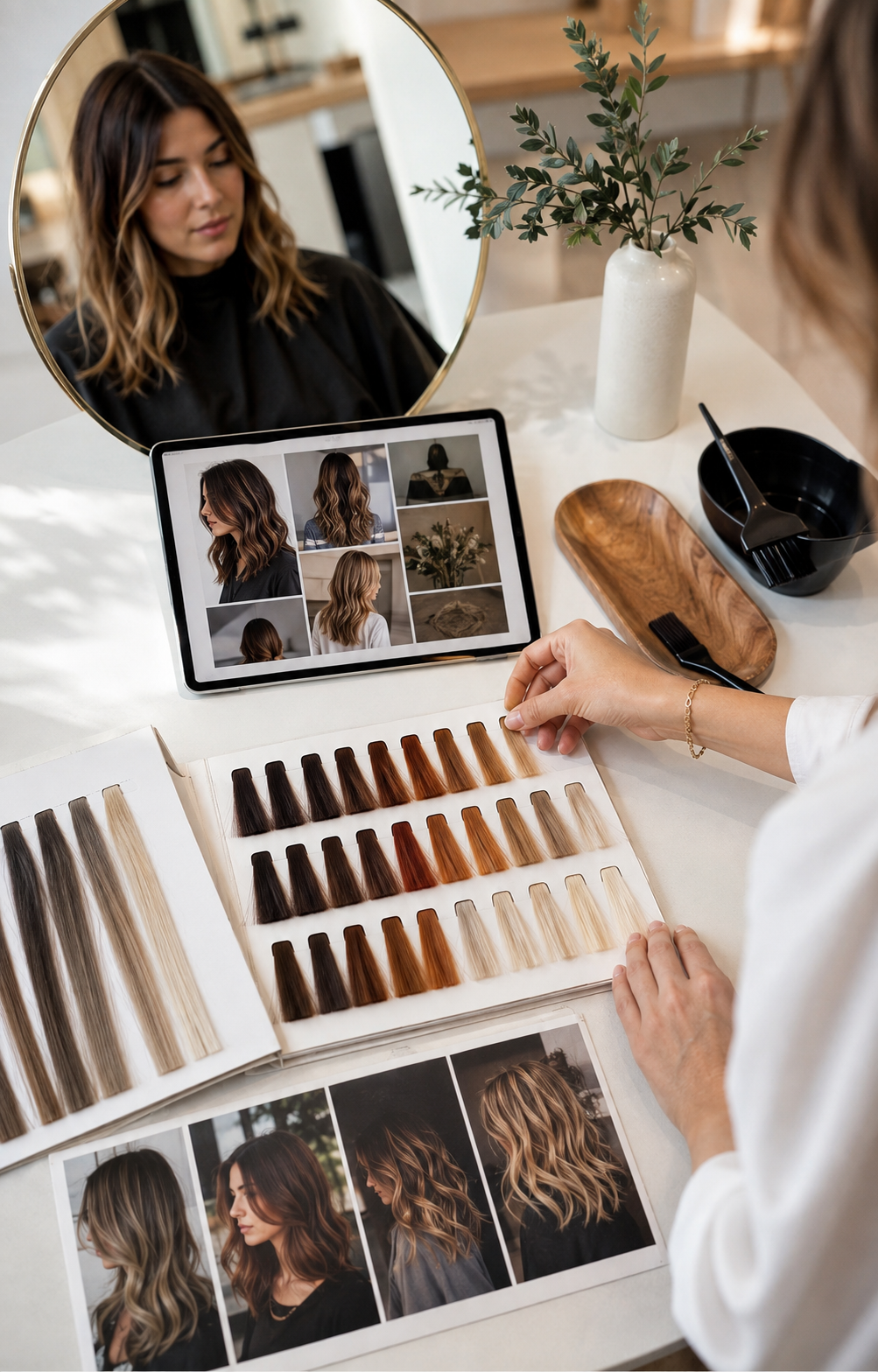
Collect three kinds of images: the overall color you like, the placement you like, and an example that shows what you do not want. Label each image. "Like the soft root, not the blonde ends" is far more useful than presenting ten unexplained photos.
The 30-second final check
Before booking, complete this sentence: "I want a [low/medium/high] contrast result, within [number] levels of my natural base, with [warm/neutral/cool] tone, brightness placed [location], and maintenance every [interval]." If you cannot complete it, the decision needs another round of comparison.
Preview several directions on the same portrait with StylePersona Hair Color Analysis. Keeping the face and lighting constant makes the differences easier to judge than comparing unrelated model photos.
Comparison
| Focus | Best signal | Watch for |
|---|---|---|
| Face-framing brightness directs attention toward the eyes and cheekbones. | Face-framing brightness directs attention toward the eyes and cheekbones. | Match it to your photo and routine |
| Lightness through the ends creates movement with softer regrowth. | Lightness through the ends creates movement with softer regrowth. | Match it to your photo and routine |
| A darker root adds depth and reduces maintenance. | A darker root adds depth and reduces maintenance. | Match it to your photo and routine |
| Uniform color looks graphic and polished but exposes roots more quickly. | Uniform color looks graphic and polished but exposes roots more quickly. | Match it to your photo and routine |
Salon-ready brief
“Use the article criteria to describe your goal, current hair, maintenance limit, and the result you want to avoid.”
Common Mistakes
- Choosing from one inspiration photo only.
- Ignoring hair behavior and maintenance.
- Skipping the avoid-list before booking.
Preview several directions on the same portrait with StylePersona Hair Color Analysis. Keeping the face and lighting constant makes the differences easier to judge than comparing unrelated model photos.
FAQ
Should I match hair color to eyebrows?
They do not need to match exactly. They should feel related in depth or undertone so the face frame looks intentional.
Is balayage always low maintenance?
The grow-out can be soft, but lightened hair may still require toner, conditioning, and home care. "Low root maintenance" is not the same as "no maintenance."
How many colors should I preview?
Four to six deliberate options are usually more useful than dozens: harmonious, warmer, cooler, lighter, darker, and one creative alternative. ---
Editorial Sources
- American Academy of Dermatology: healthy hair tips - Dermatologist-reviewed guidance on hair type, washing, conditioning, and heat-damage prevention.
- American Academy of Dermatology: coloring and perming tips - Dermatologist guidance on shade changes, patch testing, sun exposure, and chemical-service caution.
- StyleLens AI model disclosure - Product-specific disclosure for AI model use, generation limitations, and human-review expectations.
Related Cases
Keep Reading
What Hair Color Looks Brighter and Still Works for Work?
A flattering work-friendly hair color balances brightness, polish, and maintenance instead of simply going lighter.
How Personal Color Analysis Works: A Simple Seasonal Color Guide
Personal color is not just a season label. It is a practical range of colors that makes your skin look cleaner.
Which Hairstyle Makes Your Face Look Smaller? A Face Shape Guide
A face-slimming hairstyle is not about hiding your face. It is about balancing crown lift, face-framing layers, and hair weight.
Compare color directions on your photo
Upload a photo and compare realistic hair color directions before you commit.
Start analysis