A-Line Bob vs Inverted Bob: The Difference That Changes the Result
Compare A-line and inverted bobs by perimeter, stacking, volume, hair density, face effect, styling, and grow-out.
Quick answer
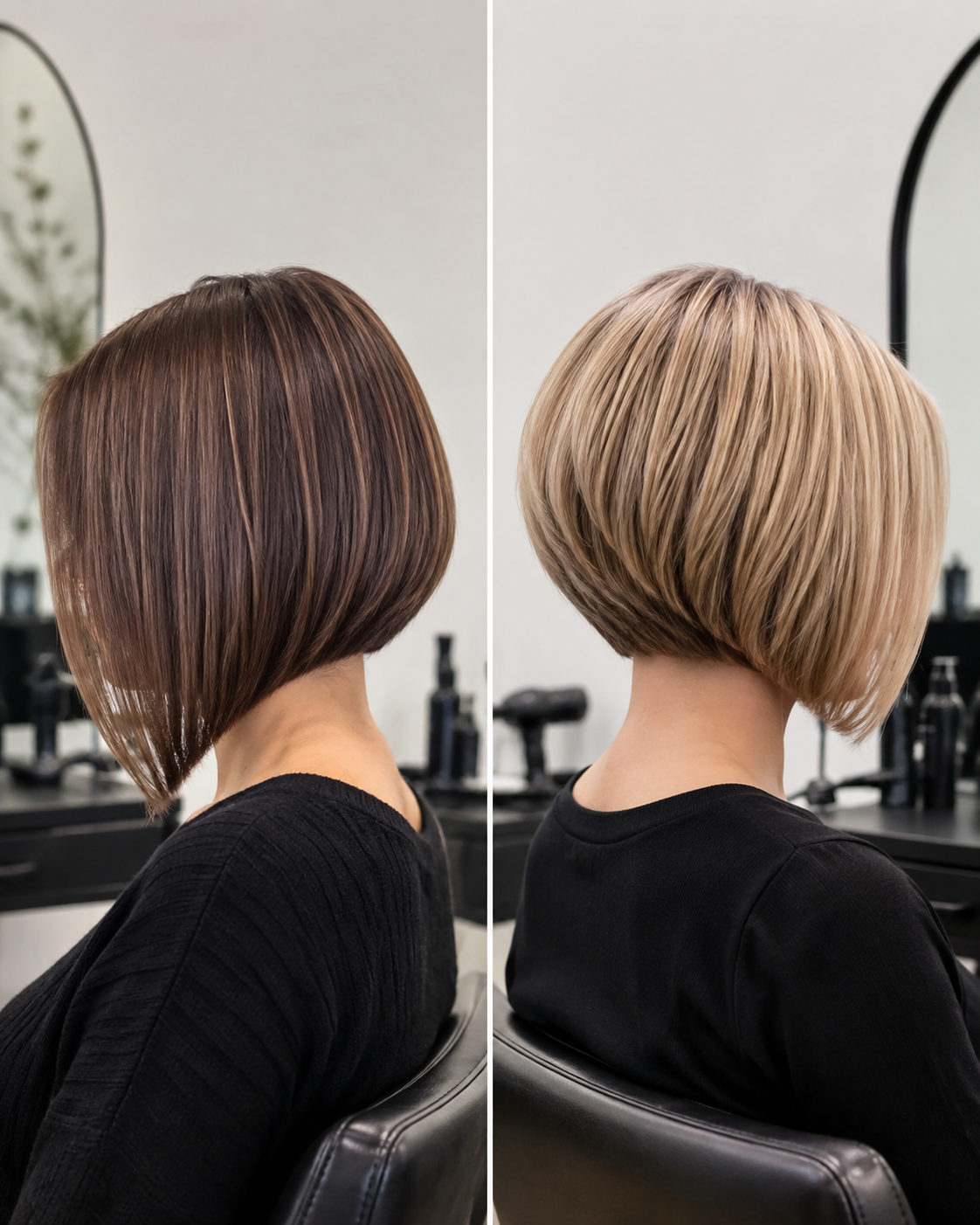
Both cuts are shorter in back and longer in front, but an A-line bob is defined mainly by its angled perimeter, while an inverted bob adds graduation or stacking through the back. The A-line feels cleaner and denser; the inverted bob creates more built-in roundness and lift.
Article
Choose A-line when
You want a modern, clean line; your ends need to look dense; you prefer minimal layering; or you want an angle that grows into a regular bob without an awkward back. It suits straight and softly wavy hair especially well, though texture can be adapted.
Choose inverted when
You want visible crown or back volume, enjoy a sculpted silhouette, and are willing to maintain the shape. It can be useful for a flat occipital area, but the amount of stacking should match hair density and contemporary style goals.
Face effect
A longer A-line front creates vertical framing. An inverted bob creates rounder volume at the back and can feel more energetic. For a square jaw, a line ending exactly at the jaw emphasizes it; below-jaw length softens. For a round face, control side width and keep the front long enough to create direction.
The most common confusion
Reference boards often label every angled bob "inverted." Do not rely on the name. Point to the back shape, perimeter, and amount of visible stacking you want. Ask the stylist to show the graduation level before cutting.
Salon briefs
A-line: "Clean angled perimeter, minimal graduation, dense ends, subtle longer front."
Inverted: "Moderate stacked volume at the back, longer front, soft transition, no exaggerated wedge."
Compare both silhouettes with StylePersona Hairstyle Analysis before committing to the shorter back.
Comparison
| Focus | Best signal | Watch for |
|---|---|---|
| You want a modern, clean line; your ends need to look dense; you prefer minimal layering; or you want an angle that grows into a regular bob without an awkward back. It suits straight and softly wavy hair especially well, though texture can be adapted. | You want a modern, clean line; your ends need to look dense; you prefer minimal layering; or you want an angle that grows into a regular bob without an awkward back. It suits straight and softly wavy hair especially well, though texture can be adapted. | Match it to your photo and routine |
Salon-ready brief
“A-line: "Clean angled perimeter, minimal graduation, dense ends, subtle longer front." Inverted: "Moderate stacked volume at the back, longer front, soft transition, no exaggerated wedge." Compare both silhouettes with StylePersona Hairstyle Analysis before committing to the shorter back.”
Common Mistakes
- Choosing from one inspiration photo only.
- Ignoring hair behavior and maintenance.
- Skipping the avoid-list before booking.
Compare the direction on your own photo before committing.
FAQ
Which bob is better for fine hair?
An A-line usually preserves density. A lightly inverted bob can add lift, but excessive stacking may expose sparse ends.
Which is lower maintenance?
The A-line is generally easier to grow out. The inverted shape depends more on graduation staying in the correct position.
Are these the same as an angled bob?
"Angled bob" is a broad description. A-line and inverted are more specific structural versions. ---
Editorial Sources
- American Academy of Dermatology: healthy hair tips - Dermatologist-reviewed guidance on hair type, washing, conditioning, and heat-damage prevention.
- American Academy of Dermatology: coloring and perming tips - Dermatologist guidance on shade changes, patch testing, sun exposure, and chemical-service caution.
- StyleLens AI model disclosure - Product-specific disclosure for AI model use, generation limitations, and human-review expectations.
Related Cases
Keep Reading
Which Hairstyle Makes Your Face Look Smaller? A Face Shape Guide
A face-slimming hairstyle is not about hiding your face. It is about balancing crown lift, face-framing layers, and hair weight.
Are Curtain Bangs or Air Bangs Better for a Round Face?
For a round face, bangs should lengthen the center and lighten the sides rather than simply cover the forehead.
What Hair Color Looks Brighter and Still Works for Work?
A flattering work-friendly hair color balances brightness, polish, and maintenance instead of simply going lighter.
Compare hairstyle directions on your photo
Upload a photo and compare hairstyle shapes before you book the change.
Start analysis