A-Line Bob for Fine Hair: Why It Works and How to Customize It
Learn how an A-line bob can make fine hair look fuller, which angle to choose, and how to avoid a sparse or over-stacked result.
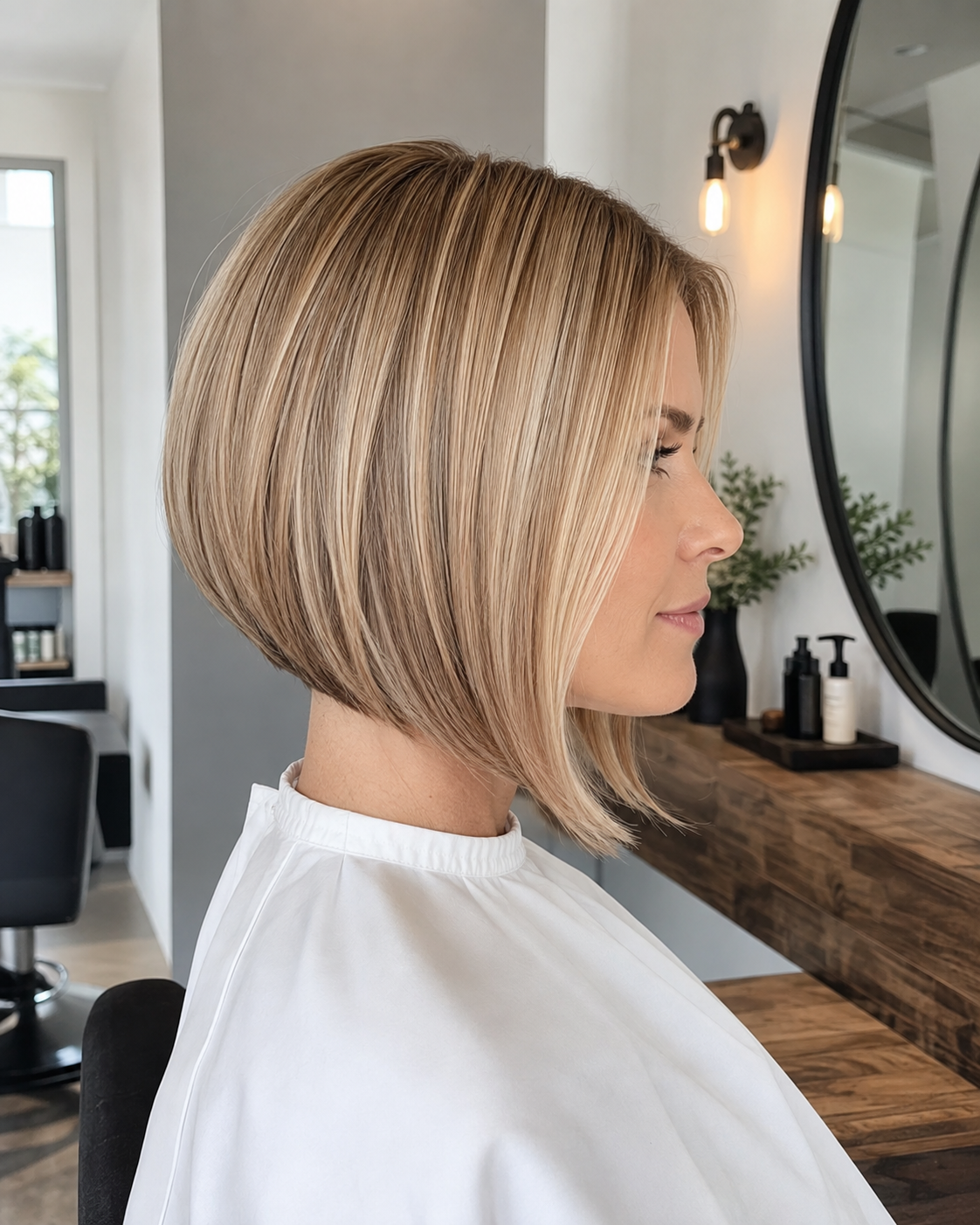
Quick answer
An A-line bob works well for fine hair because its clean perimeter preserves visible density while the slightly longer front creates shape without requiring many layers. The most wearable version is often subtly angled rather than dramatically stacked: strong enough to look intentional, soft enough to grow out gracefully.
Article
What makes a bob "A-line"
The perimeter is shorter at the back and longer toward the front. Unlike a heavily inverted bob, it does not require obvious stacked layers. That distinction matters for fine hair because too much graduation can leave the lower back sparse or make the shape dependent on blow-drying.
Choose the angle
- Subtle angle: low maintenance, polished, easiest grow-out.
- Moderate angle: more visible shape and front length, still versatile.
- Dramatic angle: strong fashion statement, higher precision and styling needs.
Choose the front length by goal
At the chin creates a crisp frame. Below the chin produces more vertical length and is often preferred for round faces. Near the collarbone offers tying flexibility but can flip against the shoulders. The best length is where your natural bend supports rather than fights the line.
Layer carefully
Fine dense hair may tolerate light internal shaping. Fine low-density hair usually looks better with a nearly one-length perimeter. If the stylist recommends thinning shears, ask what specific bulk they are removing; fine hair does not automatically have bulk to spare.
Styling plan
Direct roots away from their habitual fall, smooth the perimeter, and add only a slight bend. Over-curling can hide the clean A-line geometry. Use lightweight heat protection and avoid concentrating oil at the roots.
Salon brief
"I want a subtle A-line bob with a strong, dense perimeter, front length just below my chin, minimal graduation, and no wispy ends. It should work straight or with a soft bend and still look intentional as it grows."
Preview angle and front length using StylePersona Hairstyle Analysis, and compare the structure with the related A-line vs inverted bob article.
Comparison
| Focus | Best signal | Watch for |
|---|---|---|
| Subtle angle | low maintenance, polished, easiest grow-out. | Match it to your photo and routine |
| Moderate angle | more visible shape and front length, still versatile. | Match it to your photo and routine |
| Dramatic angle | strong fashion statement, higher precision and styling needs. | Match it to your photo and routine |
Salon-ready brief
“"I want a subtle A-line bob with a strong, dense perimeter, front length just below my chin, minimal graduation, and no wispy ends. It should work straight or with a soft bend and still look intentional as it grows." Preview angle and front length using StylePersona Hairstyle Analysis, and compare the structure with the related A-line vs inverted bob article.”
Common Mistakes
- Choosing from one inspiration photo only.
- Ignoring hair behavior and maintenance.
- Skipping the avoid-list before booking.
Compare the direction on your own photo before committing.
FAQ
Does an A-line bob add volume?
It creates the appearance of density through a strong outline. Subtle graduation can add shape, but styling still controls root lift.
Is it good for a round face?
Yes, particularly when the front falls below the chin and the sides are not excessively wide.
How often does it need trimming?
Precision bobs show growth sooner than long layered cuts. A subtle angle generally grows out more gracefully than a dramatic one. ---
Editorial Sources
- American Academy of Dermatology: healthy hair tips - Dermatologist-reviewed guidance on hair type, washing, conditioning, and heat-damage prevention.
- American Academy of Dermatology: coloring and perming tips - Dermatologist guidance on shade changes, patch testing, sun exposure, and chemical-service caution.
- StyleLens AI model disclosure - Product-specific disclosure for AI model use, generation limitations, and human-review expectations.
Related Cases
Keep Reading
Which Hairstyle Makes Your Face Look Smaller? A Face Shape Guide
A face-slimming hairstyle is not about hiding your face. It is about balancing crown lift, face-framing layers, and hair weight.
Are Curtain Bangs or Air Bangs Better for a Round Face?
For a round face, bangs should lengthen the center and lighten the sides rather than simply cover the forehead.
What Hair Color Looks Brighter and Still Works for Work?
A flattering work-friendly hair color balances brightness, polish, and maintenance instead of simply going lighter.
Compare hairstyle directions on your photo
Upload a photo and compare hairstyle shapes before you book the change.
Start analysis